
Supporting Your Child’s Eating and Development Series: Part One
Understanding the BodyBeing Stage (Ages 0-7)
This blog is Part One of the Supporting Your Child’s Eating and Development Series; Part Two and Three to come.
What’s happening in your child’s brain?
Did you know that the brain takes approximately 25 years to fully develop through childhood. The brain develops from the bottom up, beginning with the brainstem and moving toward the limbic and cortical systems. During the ages of 0–7, development is strongly influenced by the brainstem. This part of the brain is focused on safety, basic body signals, and regulation. During this time, the child is in the BodyBeing stage of development, where the world is experienced through the senses and the goal is finding their place in the world through secure attachment. Children naturally gravitate toward pleasant sensations and recoil from unpleasant ones. Feelings are very simple at this stage, often limited to basic categories like “mad, sad, bad, and glad.”
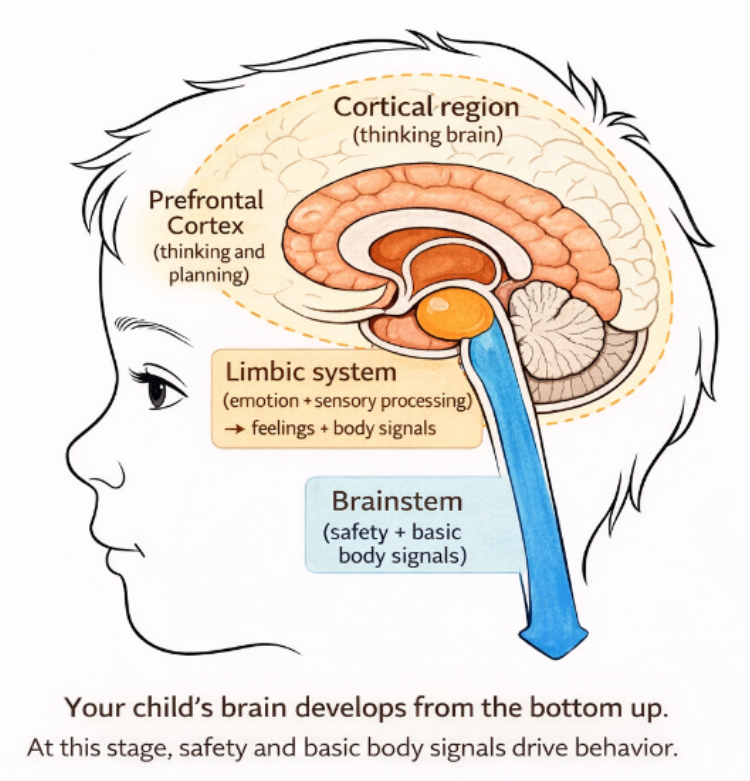
This handout is informed by the Natural Learning Relationships (NLR) framework and the BodyBeing stage (Josette Luvmour & Ba Luvmour).
Why this matters:
Children this age explore through sensory play
Pressure to eat foods that may feel overwhelming, unpleasant, or scary can lead
to pushback at best, and harm at worst
Food exposures at this stage are about exploration, not consumption
Behavior at this stage is driven more by body sensations and safety than by logic
How this shows up with food:
Exploring food through touch, smell, and play
Becoming more selective as awareness and choice develop
Showing distress or meltdowns when expected to eat foods that feel overwhelming or unpleasant
Eating more on some days and less on others
Repeating familiar foods to establish what feels safe
Eating and enjoying a food one day and refusing it the next
Showing strong preferences for how foods look, feel, or are presented
What your child needs most
To feel safe and protected
To feel a strong sense of belonging
To develop secure, trusting attachments with caregivers
To receive calm, body-to-body support from caregivers while learning to regulate their body and emotions
What can increase stress at meals
Experiences that feel physically or sensorily overwhelming or threatening
Lecturing or trying to reason in the moment
Pressuring a child to eat foods that feel overwhelming or unpleasant
Using fear, control, or power to set limits
Insisting on one approach without offering flexibility or choice
Using food as a reward or punishment
Expecting a child to eat when they are dysregulated or not ready
Safety in the Body → Openness to Food
Pressure or Threat → Shutdown/Disgust
What helps
Loving, nurturing touch that communicates unconditional acceptance
Warmth and comfort from both caregivers and the environment
Exploring solutions together by asking questions and allowing time for responses
Staying calm and providing kind but firm and consistent boundaries to keep the child safe
Lots of opportunities for sensory exploration through play and daily experiences
Engaging in play with them on their level
Modeling flexibility, give-and-take, and adaptation
Providing consistency and predictability in routines and expectations
Providing regular meal and snack times (structure supports regulation and predictability)
Deciding what and where food is served
Allowing the child to decide whether and how much to eat (Division of Responsibility; Satter, 2000)
Sharing meals together as a family as often as possible
Creating a feeding environment that feels calm, supportive, and safe
Noticing how your child responds to different environments and sensory input
Providing a variety of foods to explore
Allowing food exploration to include all senses, without the expectation of consumption
Parents can ask Themselves:
Is this building trust or is this taking away trust?
Is this creating fear of food or comfort with food?
These simple questions can serve as a gauge of how we are doing with our children.
We can also turn these questions toward ourselves:
Am I maintaining trust in my child and in myself?
Am I creating comfort and safety in my body, or adding anxiety to this moment?
If there is suddenly resistance in the child, how might I have applied pressure?
Children in this stage need, above all, a sense of safety and belonging. When these are in place, it creates the foundation for not only physical nourishment but also emotional and relational wellbeing for the whole family. As adults, whether parents, educators, or providers, we are called to understand how young children experience the world so we can respond in developmentally appropriate ways. A Natural Learning Relationships approach, together with responsive feeding, supports the child’s developmental perspective with the attunement, kindness, and compassion that allow health and wellbeing to emerge.